Friday, March 25, 2011

Thursday, March 10, 2011

Bolt Barrel Breech Bullet... What?? Terms and Structures Guide For New Shooters Part II - BOOM Goes the Dynamite!!

A guy in my office is looking to buy his first handgun. He went to talk to me and another guy who sits close by, about it. We started asking the standard questions, and we found that our terms and the terms that he was using were not at all the same, so if you are not around guns at all, I decided to work up a little guide.
This is part two dealing with ammo. Part one dealt with gun parts. Part three will deal with types of guns and their uses.
Part I, Part II, Part III

Ammo, Pills, Bullets, Caps

What goes boom? It isn't gun powder. Gun powder, or black powder, hasn't been used for a very long time, and your standard auto loading pistols and rifles would not work with it, but I am getting ahead of myself. The modern firearm is based upon the self contained cartridge. By self contained, I mean everything that is needed to fire the projectile is contained in one handy package. This package is properly called a cartridge, but is also called a "round."

Never ever ever ever ever ever ever ever ever EVER call this type of cartridge a "shell." A "shell" is an entirely different kind of cartridge.

First you have the bullet, or the projectile. The bullet sits atop the propellant, smokeless powder in most cases. The propellant sits atop the primer, and the Casing holds everything together. The casing used to be, and still is in some cases, made of brass, so sometimes spent casings are called "brass."

Primers

Great, what does this mean to you? Well, the magic is in the primer. In the good old days you had to poor gun powder and ram your projectile down on top of it. A little power would be placed, or spill, in to a pan at the trigger area and when you pulled the trigger some flint or a match or something would ignite that little bit of powder. The fire from that spark would travel through a tiny hole and ignite the main charge. If the charge did not go off, it was called a "flash in the pan." So, as you can imagine, reliability was a real problem. Now a days, we took that pan charge and put it where it would always ignite the main charge, and always be in the same spot. This is called the primer. With a center fire round, the primer is on the flat end right in the center as the name implies. It is that picece of metal that is a different color than the rest of the casing.
The primer is not unlike a standard match head. In it is a little bit of explosive material that sparks when struck. There is very little explosive material in the primer, but you really don't need much, because the real boom comes from the propellant charge that is set off by the primer.

Propellant

The propellant is typically smokeless powder. Kind of a misnomer because it is really more like smokeless gravel. Anyway, it is the stuff that goes boom. The gun and the casing keep the resulting gases of this explosion pointed only one way, down the business end of the gun.
It was found that gunpowder, your saltpeter, sulfur, and charcoal mix produced a lot of smoke. This was bad for many reasons. So a new type of powder was developed, and it was found to burn better, with minimal smoke, and was much more powerful than gunpowder. This development was as big of a change in the firearm since the invention of gunpowder itself. With this cleaner, more powerful powder a person could carry more ammunition, could see what he was shooting at after the first shot, and his guns would not rust as quickly.
Another problem with gunpowder is that it just didn't burn very cleanly. It would produce a soot that would foul every gun that fired it. Smokeless powder burned very cleanly in comparison, and with nothing fouling the action of the gun, weapons that fired multiple rounds using a complex action could be produced. Without smokeless powder, the modern self loading firearm would foul with in two or three shots. With smokeless powder, the auto loading firearm becomes a reality.

There are some things that you should know about smokeless powder. First, the amount (mass) is measured in grains(gr). 1 grain = 64.79891 mg, or about 437.5 grains = 1 oz.
How much powder you can put in to a cartridge depends on how large your casing is, and how strong the barrel of the gun you are using is. Typically, there are published tolerances published for the parts of guns so that you can be sure that the round you are using isn't too hot (too much powder) for the gun. Really that is all you need to know for a beginner, if you want to know more start looking in to literature on home loading. For all intents and purposes, the stuff you buy in the store will all go through your guns no problem... Provided you bought a well maintained firearm...

As you look at ammunition you will notice that some the ammunition designated for pistols will be noted with a P, or a +P. As smokeless powder got better and stronger, not so much of it was needed to produce the same power as the older stuff. So, some cartages could handle more powder than they traditionally held with the weaker powder. After some testing, manufacturers found that they could put the full charge of the new stuff in to the cartridge and it would function just fine in the pistols they tested. So, a new designation was created.
The "P" stands for pressure. The rounds that are more powerful are called "+P." Your gun's manual will let you know if you can use the +P round. Nearly all new pistols do.

Projectile

The projectile, or the bullet, is what puts holes in things. Typical bullets are made of lead. Why? Couple of reasons. Lead is a malleable substance, in other words it is soft and easily shaped. Lead is easy to find and cheap to use. Remember that a bullet travels very fast. Sir Newton teaches us that energy is conserved, so, during a collision, that energy has to go somewhere. Because of its unique properties, Lead will not shatter when it strikes something, like iron or steel would. Lead will deform rather than shatter thus loosing its shape, but not shedding any mass. The longer you keep your mass, the more energy transfer will occur between two objects in an elastic collision.

There are all types of different bullets you can buy for all sorts of different tasks. Most often, hopefully, you will be buying Full Metal Jacket (FMJ) bullets. Lead, as you might know, is toxic. The FMJ bullet has a thin coating of steel around them. This allows them to keep their shape, allows them to be handled safely, and not leak their lead out. This round is used in target shooting.

FMJ Bullet

The other typical round that you will buy, if you are looking to hunt or use your gun for self defense, you will buy hollow point bullets. These bullets are designed to flatten out when they strike something. They transmit all of their energy in to the target. They do this by having the nose of the bullet hollowed out, thus their "hollow point" name.

Hollow Point bullet


Why is one round used for target practice and one for hunting and self defense? It has to do with how the bullets are designed, how they transmit their energy and where will the bullet end up after striking the target.
The FMJ bullet is designed to maintain its shape, that means that it is really good at passing through objects. This is great if you are worried about the environmental impact of your bullets, you aren't going to spit lead everywhere, and especially great if you are looking to minimize the tissue damage done by your bullet. Not so great if you are unsure about what is BEHIND your target. You see, a FMJ bullet maintains its energy as it passes through tissue, and , as long as it doesn't strike bone, will likely pass directly through what you are shooting at. If you don't absolutely know that something will stop your bullet directly behind your target, this is not a good round for you.
If you have ever heard of the single bullet theory behind the Kennedy assassination, that was because the bullet was a FMJ bullet.

The "magic" bullet. This passed through two people, bounced off bone, and all sorts of other stuff. Notice how it is just slightly deformed.

Hollow Points are designed to mushroom during impact to vastly expand tissue damage, and to dissapate their energy inside the target. What that means is that the bullet opens up along the hollow point. This acts like speed breaks on an airplane, only with tissue. The bullet is unlikely to have the energy to exit the body, after these breaks have been deployed. This is great if you are looking to maximize the trauma caused by the bullet. Especially great if you are not sure of what is directly behind your target. In your house for instance, if you are shooting at an intruder, do you really want your bullets passing through the bad guy, through the sheet rock, and in to your kid's bedroom? No. Hollow points for you, then.

Before and after with a hollow point. Notice how the bullet opened up.

Shotgun Ammunition

Shotgun cartridges use all the same components as other cartridges, with one very large difference. Instead of a single solid projectile, the shotgun cartridge has several balls packed close together, called "shot", and a piece of wadding to hold them in. Only shotgun cartages should be called "shells." Nothing else. Want to look like an idiot with gun guys? Call your non shotgun ammo "shells."

Shotgun shells also come with a single metal bullet, called a slug. These rounds are for hunting something other than birds.

Caliber

Caliber is the diameter of the barrel of the gun, we will get in to barrels later. Bullets are matched to the diameter of the barrel they can spin down. So if the diameter of the barrel is 0.22 inches, the ammo that you need are .22 caliber. The actual bullet's diameter will be very slightly less than 0.22 inches. Anyway, calibers are measured in inches, millimeters, and gauge in shotguns.
Millimeters and inches are accepted measures all over the world. If you don't know what they are, you shouldn't be shooting. Anyway gauge is still a diameter of the barrel of a shotgun, but it is an old school measurement for cannon having to do with the weight of a sphere of lead that could be put in to the barrel. So... a 12 gage shotgun could have a sphere of lead weighing 1/12 of a pound put down the barrel, a 20 gage 1/20 of a pound and a 410, 1/410 of a pound... wait what? No, the 410 is actually a caliber measurement. Just when you thought things were making sense right?

Gotchas

There are several "gotchas" with ammunition. Mainly having to do with the type of ammo that you need to put in to your gun. It is VERY important that you match the correct round to your gun. You could really hurt yourself, and your firearm, by using improper ammo. So what are the gotchas? With pistols, you need to make sure that they kind of ammo that you have is the kind that fits your gun... For instance, you have a .45 automatic pistol. Will .45 Colt fit? You have a 9mm pistol. Should you use 9mm Parabelum, or 9mm Luger? You have a .22 rifle. Will .22 magnum fit? Any why is a .44 round more powerful than a .45? .45 is bigger right??

The similarity in naming is what messes most people up. The .45 Colt is actually a revolver round, and the round for the .45 automatic is the .45 ACP (Automatic Colt Pistol). The 9mm Luger and 9mm Parabelum is the same round, and the .22 magnum will not fit in to a .22 Long Rifle. You need to read your gun's owner's manual very carefully to prevent any mistakes. It could mean the difference between a fun day at the range, or a painful trip to the ER.


Next Section - Gun Types

Wednesday, March 2, 2011

Really Tae Kwon Do?


You are still wearing the super thick hogu?? Even after years of evidence that you won't drop dead after getting kicked? Really? I mean it is ok to wrap up kids. You do have over protective parents to worry about, but for adults? For adult males???? Seriously??? You know who doesn't use chest protection??? ALL OTHER COMBAT SPORTS!!!
Stop the stupid TKD. Just stop it.

Tuesday, March 1, 2011

American Top Team

It's a new quarter, so that must mean that I have joined a new gym! I went looking for classes I could make and still hold on to the scared dinner time that I MUST have with the wife. If I don't get my wife time I start to go nuts. Anyway, I found that American Top Team had a 7am BJJ class, and a 9am Muay Thai class. I have been working from home about two or three days a week, so I thought that I could swing the 7am BJJ classes then head to the office, and on the days that I worked from home, I could work for a while, then hit the Muay Thai class later on in the morning. I went to their web site to check them out.

The head BJJ instructor is Giulliano Gallupi. He is a black belt out of Nova União in Brazil, like many of the ATT guys. He has many championships, but does not have the background of world champion and over all BJJ bad ass Lovato Jr. However, he is a much better BJJ guy than me, and a legit black belt out of a very solid Brazilian school. That is good enough for me, as I only saw Lovato Jr. once in the year I was at his school.

The MT instructor is Eduardo Maiorino. Eduardo has fought at the highest levels in MT for western fighters. He has been in the big K-1 tournaments, fought the big names and did alright... He did get knocked silly by Duke Rufus in 2003. He never seemed to get out of the regional events, seeming to always loose before getting to the big GP in Japan. However, he is a super duper legit MT guy.

I went to a free trial class for MT and went through a class with Edwardo. He was fun to work with, gave great combos, and worked me in to the ground. Not hard with my cardio the way it is. He seemed very excited to work in the US with us, and continually shouted out the traditional Brazilian encouragement phrases of "Let's go guys!!" and "Work hard my babies." Apparently that is a Brazilian thing. They all do it.

I came back to the gym to try out the BJJ morning class and found that the attendance was very low... It was another blue belt Giulliano and me. Essentially it was a private class.
After a tough warm up, reminded me of the good old days at Doc Stiner's doing updowns until I threw up, we went through passing the guard. Lots of really really good stuff. I have never had a one on one lesson with a black belt, and it was really nice to learn where I was making a lot of mistakes. The bad part was that my cardo is so bad that when it came time to spar, I had very little in the tank to represent my former schools. I got owned, and owned badly.
All in all, very positive experience.

I came back the next day at 9am to do Edwardo's class. Again I found that only a couple of students were there, so I got to train with Edwardo basically by myself. He said my kicks were not fast, and that my left leg was weak. Good to know... Again my cardio let me down and I completely gassed out during pad work with him. He was tossing out excellent combos making me think and work hard, I just couldn't keep up with the pace.

After class, to my surprise, Giulliano remembered my name, and asked if I would be in class tomorrow. I assured him I would, and left the gym happy that this place was making an attempt at building a fighter family. Positive experiences all around.

I know for sure that this place won't be asking me to teach. That is a very good thing, because I just want to train. I also know that this place won't be holding back the tough exercise. When I was working out both instructors seemed frustrated at my lack of cardio, and by the work outs they put me through, my guess is they have a base level of fitness that they want their students at. Because there are so few people in the class, it is hard to hide from the hard work, so that is a very good thing for my gas tank.

One extreme draw back is the cost. It is stupidly expensive. STUPIDLY expensive. I am used to training for under $100 a month, and this place puts the price tag up near $170 a month. Freaking ouch. I could get the price under $100, but that is only with a year contract, and I just didn't want to do that, because I have no idea what my schedule will look like in a year. It could be that I can only do this kind of training for another couple of months... So, I bit the bullet and signed up for three months at $170 a month. Ouch. But I know that my schedule will be stable for that amount of time. The wife's rotations will be predictable for that amount of time, and I know I will be on the same contract for at least three more months.

It feels good to be training again!

Thursday, February 24, 2011

Bolt Barrel Breech Bullet... What?? Terms and Structures Guide For New Shooters Part I - Parts of The Gun

A guy in my office is looking to buy his first handgun. He went to talk to me and another guy who sits close by, about it. We started asking the standard questions, and we found that our terms and the terms that he was using were not at all the same, so if you are not around guns at all, I decided to work up a little guide.
Part I, Part II, Part III

How They Work

At their heart, guns are very simple devices. They are basically tubes with an explosive charge at the base. The tube must be strong enough to withstand the pressures of the explosion and force the projectile out of the open end of the gun.

Barrel

What are the basic pieces that make up a firearm? They haven't changed since guns were first constructed. You need a breech, a Barrel, and some sort of trigger.

The barrel is what the projectile moves down. Why is it called a barrel? Back in the good old days people did not have the knowledge or teleology to cast metal in to a solid cylinder. They did know how to make many small curved staves of metal. So they would create these staves of metal, and put them all together with iron hoops, just like they did to make wooden barrels. Thus, the name. The ends of the barrel have special names. The front is called the muzzle, and the rear, the breech.
The inside of the barrel is called the bore. The bore is very important to the flight of the projectile. There are two types of bores that are used. The smooth bore, and the rifled bore. The smooth bore is just that. The bore is smooth all the way down to the breech. There is nothing in the bore to affect the flight of the bullet.
The rifled bore has spiral groves cut in to the bore to spin the bullet as it leaves the barrel. This stabilizes the flight of the bullet, and causes it to be more accurate.
Guns that have the rifled barrels are called "rifles."

Magazine

The magazine is where ammunition is stored. With firearms it is where a firearm, capable of repeatable fire, keeps its ammunition. Shotguns typically use a tubular magazine underneath the barrel of the gun. Handguns have a removable magazine, or a revolving magazine, and rifles have a number of different types of magazines, from internal magazines to removable magazines, to tubular magazines.

This is a pistol magazine.

Never ever call a removable magazine a "clip." This is the wrong term. A "clip" is something that is used to aid in the loading of an internal fixed magazine.

This is a clip!


Action

Firearms are loaded one of two ways, from the muzzle or from the breech. Obviously, those that are loaded from the muzzle are called "muzzle loaders." These types take considerable skill to operate, and are outside the scope of these descriptions.

Breech loading is the most common form in firearms these days. The problem with a breech loader is that you have a weakness at the point of explosion. To solve this you need something that will seal the breech so that the explosion only goes the way you want it to go. This is called the "block" or "breech block" or the "lock." With most firearms, the block exists as part of a more complex system called the "action."

Now we get in to where a lot of confusion occurs. The Action is typically defined as what manipulates the cartridges and seals the breech. This is a wide open term, because there a a number of ways to get this done. There are two types of actions, manually operated and, automatic. Automatic Actions are also called Auto-loading firearms. When you hear of an "automatic" handgun, it is because it is an Auto-loading hand gun.

The parts of the action very greatly depending on the type of gun. Repeating firearms have vastly more complex actions than the single shot variety. What you need to know is that the action is the part that opens or seals the breech.

Manual actions are, of course, the oldest types. That does not mean that the manual action is outdated. Indeed many new variations on the manual action are released every year. The only qualifier for an action to be a manual action is that the shooter has to do some step to enable the firearm to shoot. This can get confusing, as newer manual actions do so much mechanical work with a trigger pull that they are almost automatic.
A good example of a simple manual action firearm is the break action shotgun:


As you can see the action is manipulated by a leaver that breaks open the breech. Shells are then extracted and fresh ones inserted the action is again locked and the gun is ready to fire.

Automatic actions are newer and they, like their name implies, do all of the work for you. An automatic action typically uses the recoil or the gas of the exploding powder to run their cycle.
An example of automatic action is the Bretta 92:
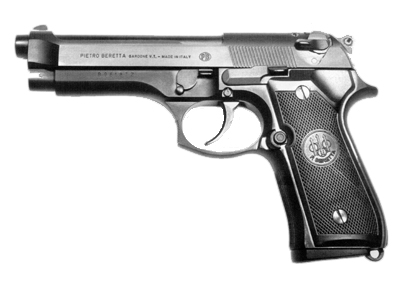


Parts of the Action

Pieces parts!!
Parts of the action in a repeating firearm are remarkably similar. In a manual actions and automatic actions you are going to have something called the "bolt." The bolt is nothing more than a spring loaded piece of shaped metal. This piece acts as the breech block and housing for the firing pin (more on that guy later) and extractor.
In operation the bolt is moved backward, opening the breech. The extractor is a piece that grabs the spent casing and tosses it out of the chamber. A new round is brought up from the magazine and the bolt moves forward to put it in the chamber. The bolt then locks around the fresh round, and the firing pin is cocked backward.
Here is a bolt action rifle with the bolt open:


With pistols, the bolt is combined in a single piece called the "slide." Literally the entire top part of the pistol will move backward when firing. The back half of this is mostly all steel, the bolt.


Working the action

Now comes some confusing stuff... With the advent of repeating firearms, there has been the concept of single shot, semi-automatic, and automatic fire. This has to do with what happens when the trigger is pulled. All manually operated firearms are considered "single shot." One trigger pull, one shot. The action has to be worked manually for another shot to occur. That said, the only guns ever called "single shot" are the ones that can only only shoot once. A pump action shotgun is not called a single shot, it is called a pump action.

Semi-Automatic means that you get a shot every time you pull the trigger. There is no manual action that needs to occur between shots, just pull the trigger, boom.

Automatic means that the gun fires as long as the trigger remains pressed. Pull the trigger, boomboomboomboomboom.

Trigger

The trigger is where the magic happens. Unfortunately, this is also where a lot of confusion reigns. The trigger has essentially three pieces. The actual trigger, the thing you pull with your finger, the hammer, and the firing pin. What happens when that trigger is pulled, especially in pistols, is what is cause for much of the confusion.

A typical firing action happens like this: The shooter pulls the trigger. The trigger releases the hammer, which is under tension by a spring. The hammer falls upon the firing pin, which strikes the primer (more on this later) which fires the gun.
That would be pretty simple, but designers have found ways around the hammer. This means you can seal up the trigger completely enabling the gun to work much more efficiently, and making them easer to operate. These hammerless designs have revolutionized all guns.

Now, let's step back for a moment. Many firearms still have a visible hammer. It is the thing you always see people cocking backward in the movies. In the pistol world, guns are still designated by having that hammer involved in the mix, even if that hammer doesn't exist. Having fun yet?
Repeating pistols are separated in to two categories by what "happens" when the trigger is pulled. Happens is in quotes because designs have evolved to eliminate most of what used to make up the definitions. But here we go anyway:
In the pistol world you have double action pistols and single action pistols. Double action pistols have triggers that have very long trigger pulls, and can cock the hammer, then release it all with a single trigger pull. A single action pistol, only releases the trigger when the trigger is pulled.
An example of a single action pistol is the Colt 1911 pistol.

The 1911 will only fire if the hammer is cocked back. The good news is that it does this for you automatically every time you fire the pistol, but the first time you fire, you must have the hammer cocked.

Double action pistols are somewhat confusing. Your typical double action pistol can fire in single action, the hammer cocked, or in double action, hammer is cocked then released in the single action. An example of a double action pistol is the Colt Anaconda:


Fun time!! Coming back to what I said before about the hammerless designs. The hammerless designs many are designated Double Action Only. Wait, you say, How can they be double action with out a hammer??? Good question. When a traditional double action pistol is being shot in double action mode the trigger pull is long and heavy. You really have to want to shoot what you are aiming at for a double action to go off. The manufacturers like this thought, and they kept it when they introduced their DAO pistols. So, double action in the modern pistol sense has come to mean, really long trigger pull. Because of this really long trigger pull, companies have been able to reduce the amount of external safeties built in to their pistols. It is difficult to be just playing around with such a long heavy pull and have it go off, so why do you need an extra switch to manipulate? An example of a DAO pistol is the Glock 17.


Even more fun time! If single action and double action haven't completely blown your mind, there are also Double Action/Single Action pistols! What these contraptions are pistols that act as double action the first time they are fired, then single action after ever succeeding shot. So, you have a long hard trigger pull the first time as the hammer is cocked back and released, but after that first shot is off, the hammer remains cocked, and the trigger pull is short and light. Most modern pistols that have, visible hammers, are DA/SA. The afore mentioned Beretta 92 is a good example, and so is my very first handgun, the Smith and Wesson 5906:


Safeties

The bane of all new shooters! The external safety!
Most firearms will have some sort of mechanical safety. We will get to this in the safety post, but, in my opinion, they are all crap. They lead the shooter in to a false sense of security. How many shooting accidents have you heard about where the shooter said he thought the gun was on safe?
Anyway, a safety is a device that will keep the gun from firing. These need to be put in to the fire position before a gun can be fired.
They range from the flip safety shown on the 5906 and Beretta 92 above, from a back strap safety show on the 1911 (that piece of metal protruding out beneath the slide.) to the button safety on many shotguns.

You can tell if someone shoots a lot or not from how they manipulate the safety. Good shooters will get in to their firing position and will switch the safety to fire. They then settle in and take their first shot. After they are done shooting they will switch the gun to safe before relaxing from their shooting position.
New and inexperienced shooters will settle in then pull the trigger, nothing will happen, they then remember the safety, switch it off, resettle then shoot. The safety is then put back on as an after thought after they have relaxed from their shooting position.

Next post... Ammo!

Monday, February 21, 2011

Why Government Worker Unions are Dangerous

Money and politics. Politics and money. Government worker unions are the complete marriage of money and politics. Unfortunately it is the people's money that is being spent.

Let's take the example of a private sector business first, then expand that in to the public. The differences are what will make my argument for me.

I start a business building airplanes. If I wish to keep my business running I have to turn a profit. I can not just break even, because I must have some money on hand to buy new equipment and other capital expenditures and to increase salaries, etc. If I do not turn a profit, I have to close my doors, and sell all of my assets to pay all of my creditors. The management and staff of my company know that the money for the company is made by a quality product. If the business is run correctly, they work hard to produce just such a product. They have "skin" in the game. This is the way of the privateer.
If a government agency decides that they want to build airplanes, they do not need to turn a profit. They simply start making airplanes, asking for their budget from the congress, via their parent agency. Even if the airplane building division is run horribly, with many problems, it can still operate at a massive loss. They don't get their money from a good product, they get their money from the congress. The money will still be there even if the product is substandard.

Now we enter in unions. First I will qualify this by saying, I believe that unions have a place in the workforce. When business takes advantage of its workers, and puts them in unsafe conditions, unions are needed so that the individual labors can stand together to stop the unsafe practice. However, it is also the mandate of the State to ensure that the rights of the individual are not infringed upon by the company. Thus, the State, by force of law, should and and ought enact legislation to protect worker's rights. Such as a safe workplace. When the State steps in and does this, what is the role of the union? Collective bargaining.

So, the workers in my airplane factory unionize and come to the bargaining table. As the union represents all workers in my factory, I only need to negotiate once. If a deal is struck, everyone in the plant has the same deal. I know how well my company is doing and how much I can spend on each employee. I am only beholden to the company bottom line, thus there is a finite amount of money I can deal with. The union and I come to a deal with this bottom line in mind.

When the government worker union comes to the bargaining table, they deal with someone who is not beholden to the company, but to elected officials. The elected official, post 17th Amendment, is beholden to the people in his district. The elected official knows that if he gets the endorsement from the union, lots and lots of people in his district will vote for him. As he also has no skin it the game, and there is no mandate to turn a profit, the bottom line that the privateer has does not exist in the public sector. Unions are given nearly everything they ask for, as they essentially hold the elected official hostage with their endorsement.

This is why government unions are so powerful, and so dangerous. Government, post US vs Darby Lumber, essentially has a blank check to write. The unions know this and go after that brass ring. Ironically, the man who made this a reality, FDR, was staunchly anti union because of this very reason. His later successor, JFK, was the one who let the fox in the hen house.

Friday, February 18, 2011

Diamond DA 40


Great Shot!!


DA 40 TDI at dusk.